
You’ve booked the venue, lined up the DJ, and the flyer looks incredible. Then someone in the committee chat asks the one question nobody prepared for: “So… what are we charging?” And the room goes quiet. Learning how to price event tickets shouldn’t come down to a guess, a gut feeling, or whatever last year’s chair scribbled on a napkin.
Price too low and you sell out fast but leave money — and maybe your whole fundraising goal — on the table. Price too high and the early buzz fizzles while everyone waits to see if you’ll blink. The good news: pricing isn’t a dark art. It’s a framework. Work through these seven steps in order and you’ll land on a number you can actually defend.
Step 1: Know your true costs before you name a price
You can’t price a ticket until you know what your event actually costs to put on. So write it all down — everything. The obvious lines are the venue, catering, and talent. The ones that sink first-timers are the quiet ones: security, insurance, printing, décor, AV, staffing, the deposit you already paid, and the payment processing fees on every ticket.
Add it all up, then divide by the number of attendees you realistically expect — not your dream number, your honest one. That figure is your break-even per head. Every ticket you sell has to clear it before your event makes a single dollar for the cause.
Step 2: Know your audience and your comparable events
Numbers on a spreadsheet don’t tell you what people will actually pay. Your audience does. A scholarship gala for established alumni supports a very different price than a college homecoming day party — same city, completely different wallets.
So do the homework. What did comparable events in your area charge last year? What’s your own history — did last season’s $40 ticket sell out in a week or limp to the finish line? Ask a few honest people in your community what feels fair. You’re not looking for the highest number anyone would tolerate; you’re looking for the price that feels right and clears your break-even.
Your ticket price isn’t what the event costs you — it’s what it’s worth to the person buying it. Cost sets your floor; value sets your ceiling.
Step 3: Build tiers — and use scarcity and windows
Here’s the mistake almost every first-timer makes: one price, one ticket, take it or leave it. A single flat price leaves real money uncollected, because your audience isn’t one person — it’s a budget-conscious student, a comfortable alum, and a sponsor who wants the front table, all shopping the same event.
The fix is tiers. A simple, proven ladder looks like this:
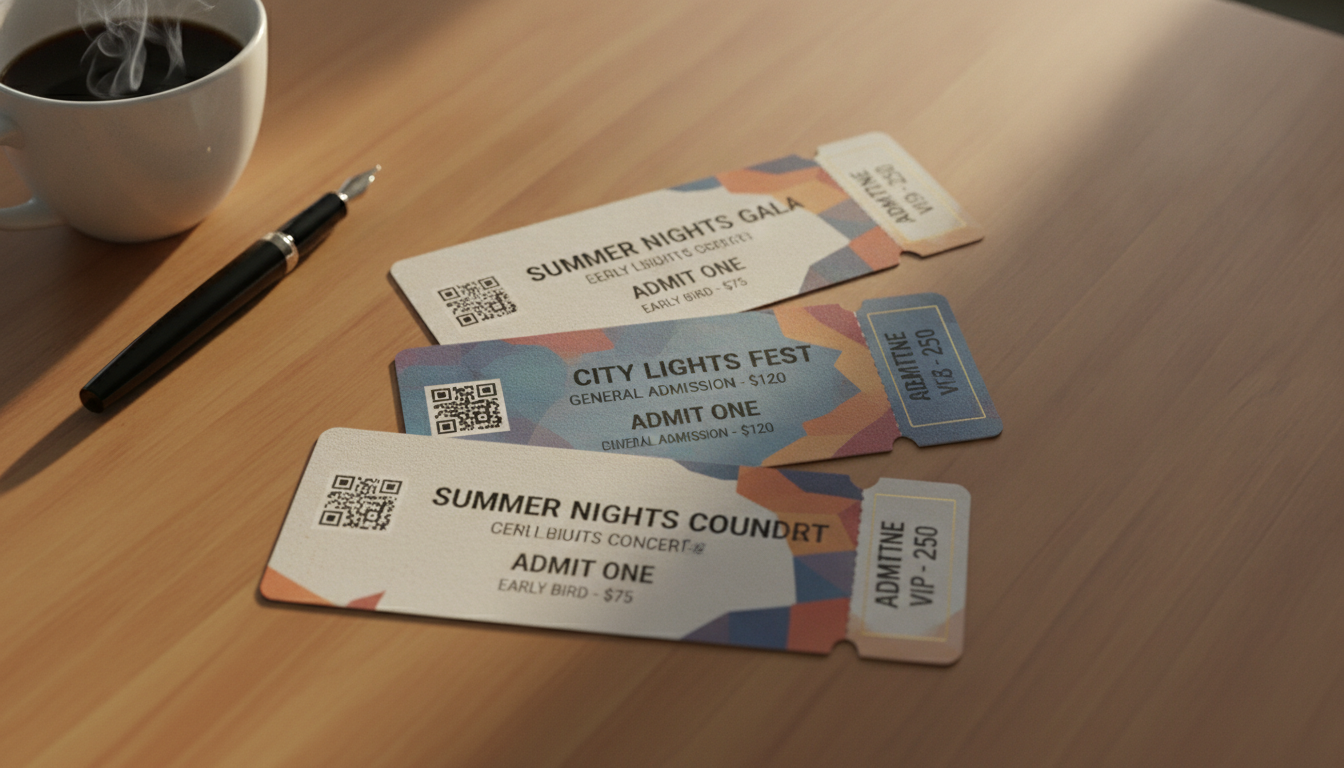
- Early Bird — a discounted price for a limited window (or a capped quantity). It rewards your most enthusiastic buyers and gives you cash — and momentum — early.
- General Admission — your standard price, the anchor everything else is measured against.
- VIP — a premium experience: better seats, early entry, an open bar, a swag bag. Some of your audience will happily pay more for more.
- Tables & group bundles — a fixed-size bundle like a “Table of 8” sold as one item that splits into individual tickets, so one person can bring the whole crew at a group price.

Scarcity is what makes tiers work. When Early Bird has a real deadline or a real cap, “I’ll buy later” turns into “I’d better buy now.” EventPassHero gives you unlimited ticket types with their own prices, quantities, and on-sale windows, so you can schedule the Early Bird to close automatically and let General kick in the moment it does — no midnight edits required.
Unlimited ticket types Timed Early-Bird windows Tables & group bundles Per-tier quantity caps
Step 4: Decide on add-ons and upsells
Some of your best revenue never touches the base ticket price. Add-ons let a buyer who’s already excited spend a little more — a parking pass, a commemorative shirt, a bottle of wine for the table, a photo package, a donation line at checkout. Each one is small on its own, but across a full house they add up fast.
Upsells also protect your headline price. Instead of raising every ticket by $10 and scaring off the budget crowd, you keep General Admission approachable and let the people who want more, pay for more. With EventPassHero you can attach optional add-ons and a donation prompt right in the same checkout, so the extra ask never feels like a separate errand.
Step 5: Absorb the fees or pass them to buyers
Every ticketing platform charges a fee. The only real question is who visibly pays it — and that’s your call.
- Absorb the fee and the buyer sees a clean, round number (“$50, all in”). You net a little less per ticket, but the checkout feels friendlier and there’s no sticker shock at the last step.
- Pass the fee and the buyer covers processing on top of your face price. You keep your full intended amount — the norm for many fundraisers, where supporters expect to cover costs so more goes to the cause.
There’s no universally right answer; it depends on your audience and your goal. What matters is that you decide on purpose instead of by accident. EventPassHero lets you choose to absorb or pass fees per event, so the math always lands where you meant it to.
Step 6: Use psychological pricing (and know when round numbers win)
Price is also a signal, and small choices in how you display it change how it reads. A $49 ticket feels meaningfully cheaper than $50, even though it’s a dollar — the classic “charm pricing” effect, and it works well for value-driven, high-volume events like day parties and mixers.
But read the room. For a black-tie gala or a premium fundraiser, a clean, confident round number — $150, $250 — signals quality and respect for the occasion. Ending your gala ticket in “.99” can cheapen the very prestige you’re selling. Match the number to the event: charm pricing for volume, round numbers for premium.
Step 7: Test, watch, and adjust
Your first price is a hypothesis, not a verdict. Once tickets go live, the data tells you the truth faster than any spreadsheet could. Selling out your Early Bird allocation in 48 hours? You probably priced it low — nudge the next tier up. Crickets after a strong launch push? The price, the timing, or the offer needs a look.
This is where a live dashboard earns its keep. Because EventPassHero shows you sales in real time, you can adjust a price, extend a window, or add a tier mid-campaign and watch the response — instead of finding out on event night that you left money on the table.
Common questions
Is there a pricing calculator?
Yes. EventPassHero includes a built-in pricing calculator that shows your net take-home per ticket after platform and processing fees, before you ever publish. You can see exactly what a $40 or $75 ticket actually puts in your account, so there are no surprises when payouts land.
Can I pass fees to buyers?
Yes. You choose per event whether to absorb the platform fee into your face price or pass it to buyers at checkout. Many fundraisers pass fees so more of every dollar reaches the cause; consumer-facing parties often absorb them for a cleaner, all-in price. It’s entirely your call.
What ticket types can I sell?
As many as you want. EventPassHero supports unlimited ticket types, each with its own price, quantity cap, and on-sale window — Early Bird, General Admission, VIP, member-only, and more. You can schedule tiers to open and close automatically so pricing runs itself.
Can I sell tables or bundles, or offer discounts?
Yes. For group pricing, sell a fixed-size table or group bundle — like a Table of 8 or Table of 10 — as a single item that splits into individual tickets, so one buyer purchases the whole table for their crew and every guest still gets their own ticket for check-in. For discounts, create coupons — a percentage off or a flat amount off, each with its own usage cap and expiry date — that buyers apply at checkout.
Can I offer add-ons or upsells?
Yes. Attach optional add-ons — parking, merch, a bottle for the table, a photo package — plus a donation prompt right inside the same checkout. It’s the simplest way to grow revenue per attendee without raising your base ticket price.
Related reading
- Sell tables, bundles, and individual tickets
- Coupons and promo codes
- Get paid in 2–3 days with Stripe payouts
The bottom line
Pricing your event tickets isn’t guesswork — it’s a framework. Start from your true costs, price to your audience’s real value, build tiers with scarcity, layer in add-ons, decide on fees deliberately, mind the psychology, then watch the data and adjust. Do that and your number stops being a nervous guess in the committee chat and becomes a decision you can stand behind.
Ready to put your pricing to work? Create your event, set up your tiers, and see your take-home before you publish — or book a quick demo and we’ll build your pricing ladder together.

Raise More Money With Less Stress.
Sell more tickets. Stay in control. Built for organizations that move the community.
Start selling tickets →